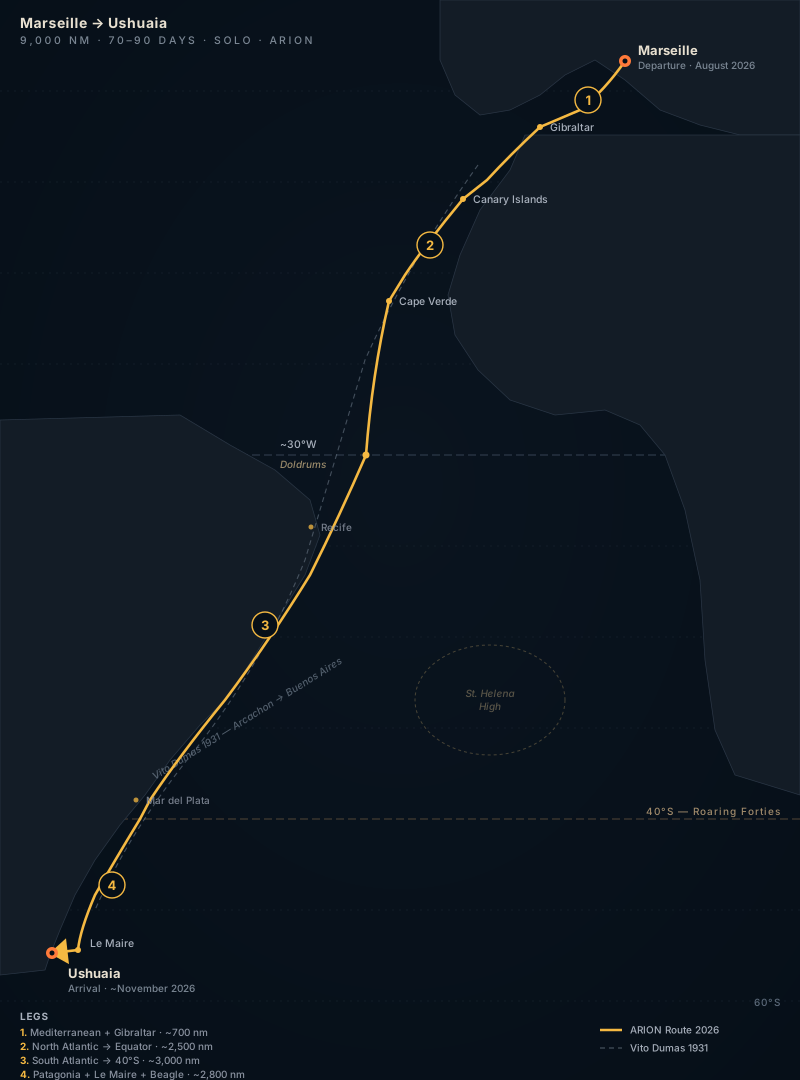
The essentials. Three months, 9,000 miles, four legs. The Act 1 transatlantic is not an exploit, it is a full-scale audit before the Drake. Marseille in August, Ushuaia in November, the boat and her skipper qualified for what comes next.
Crossing fact sheet
| Item | Value |
|---|---|
| Sailing-route distance | ~9,000 nm |
| Typical solo duration | 70 – 90 days |
| Longitude targeted at the Doldrums | ~30°W |
| Roaring Forties entry | 40°S |
| Direct historical precedent | Vito Dumas, 1931 |
| Final target of the programme | south of 60°S |
Marseille, 11 May 2026. Three months before departure. The first crossing of Odyssey of AION is Act 1 of the expedition, a solo transatlantic between Marseille and Ushuaia. About nine thousand miles, two oceans, a change of hemisphere, and a gradual exit from the world of ports. This article describes the route, the legs, the constraints, and what it prepares. I write it with the voices of those who went before me down this descent, because no sailor goes down the Atlantic without first having read the others.
Why Ushuaia, and not somewhere else
Ushuaia is not a destination, it is an airlock. It is the southernmost reachable port before the Drake Passage, and the only logical place to prepare an expedition sailboat for the Antarctic circumnavigation. There you join the crewmate, restock supplies, check one last time what the transat has stressed. Anything that needs repairing must be repaired there, because beyond the Beagle Channel there are no more parts, no more yards, no more safety net.
The Act 1 transatlantic therefore serves two purposes. It brings ARION south, and it validates at full scale what the December 2025 sea trials only sketched. A solo Atlantic descent, in long autonomy, is the trial that qualifies the boat and her skipper before the high latitudes. Bernard Moitessier put it in his own way in The Long Way, on reaching the Pacific after the capes, no longer sure whether he was continuing for the race or for something else. The transat is not a formality, it is the place where the voyage decides.
The route, an overview
Marseille → Ushuaia by sail, following the classic South Atlantic route, breaks down into four main legs:
- Mediterranean and Strait of Gibraltar. Exit westward, about 700 miles.
- North Atlantic, to the Equator. Descent via the trades through the Canary Islands and Cape Verde, about 2,500 miles, including the Doldrums.
- South Atlantic, to the Roaring Forties. West-side passage around the St. Helena High along the Brazilian coast, about 3,000 miles.
- Descent toward Patagonia and entry into the Beagle. Argentine shelf, Le Maire Strait, Beagle Channel, about 2,800 miles.
Total, approximately 9,000 nautical miles. At a realistic average for ARION solo, seven to eight knots on a direct course but five to six knots made good, you land on a window of 70 to 90 sea days. The gap between instantaneous speed and actual average comes from upwind tacking, wind holes in transition zones, detours imposed by weather strategy, and the inevitable failures that slow the boat down. Three months, in order of magnitude.
There is a direct precedent, rarely cited today, that deserves recalling. On 13 December 1931 the Argentine Vito Dumas sailed from Arcachon for Buenos Aires, solo. He arrived on 13 April 1932. Four months, on a wooden sailboat without autopilot, without weather routing, without Starlink, without anything. Ten years later he would write Los Cuarenta Bramadores and invent the "impossible route" through the Roaring Forties. Before that mythic circumnavigation, there had been a Mediterranean-to-Argentina transat, and it is on the same trace that I am going back down.
Mediterranean and Gibraltar, getting out
The western Mediterranean in August demands patience more than sailmanship. Light westerlies dominate, irregular thermal breezes, eastbound current at Gibraltar. This is the time to put the boat into transat discipline before the sea turns serious, identify what chafes, what sings, what slams, and correct while there is still time. Old sailors used to say you never really leave the Mediterranean, you are ejected by the strait, in one direction or the other.
Gibraltar is best crossed with the favourable current and a moderate easterly. Avoid the combination of westerly wind against current, which turns the strait into a short, steep wave-machine. Once through, course south-west, you start to breathe again. Morocco to starboard, the deep blue ahead, and the quiet thought that the next French shore you will touch is eighteen months away, at another quay.
Canaries, Cape Verde, the Doldrums
The north-east trades settle in around 30°N. Las Palmas remains a possible call if something has to be put right, but the idea on this transat is not to break the rhythm. If everything is holding, you pass offshore. Cape Verde, around 16°N, is the last accessible anchorage before the Equator.
The Doldrums, the intertropical convergence zone, are the least readable part of the route. A few days of squalls, encumbered calms, thunderstorms, water falling vertically. Moitessier, who crossed them several times, describes them with rare honesty in The Long Way:
"For the great square-riggers of old, the Doldrums meant exhausting days of working the heavy square sails under a sultry damp heat and a leaden sky. For us in our small yachts, the Doldrums are simply a very tiresome moment to get through, no more. Yet a sailor will approach the Doldrums with a guilty conscience."
That guilty conscience is exactly the feeling. You know you are going to lose time, lose wind, lose sleep in the squalls, and there is nothing else to do but wait. Racing boats cut west, around 25 to 30°W, to shorten the crossing. ARION does the same, without the regatta pressure.
This is where you begin to understand what long autonomy actually means. When Robin Knox-Johnston crossed the Atlantic in 1968 aboard Suhaili, his 32-foot ketch, he discovered the keel seams were leaking. No port. He dived under the boat, in mid-ocean, and caulked the joints himself. That was solo sailing then, and it has remained that. On this transat, what breaks is repaired with what you have, where you are, without calling anyone.
South Atlantic, the St. Helena High
Once the Equator is crossed and the south-east trades are picked up, the route descends at an angle south-west along the Brazilian coast. The semi-permanent St. Helena High is the strategic obstacle of this leg. You round it on the west side, between the South American coast and the western edge of the High, where the wind remains workable. Vendée Globe boats pass on the east side to reach the Cape of Good Hope, we pass on the west to reach Patagonia. It is the asymmetric face of the same obstacle.
It is worth being clear about what this leg means. The Doldrums and the Horse Latitudes are not alike. The first is a zone of slow combat against squalls and humidity, the second a zone of patience under a generally clear sky, where true flat calms remain fairly rare. It is a pleasant sea, with no major trap, but it counts in weeks. The discipline of the boat sets in: short sleep cycles, methodical checks, an unbroken log, weather read several times a day. It is also the last warm part of the voyage. Temperatures will tip quickly from the Rio de la Plata onward.
On this leg you stop being a transatlantic sailor and become a descent sailor. The difference is in the inner clock. The operational margin is built here, in a few hours of sleep taken at the right moment, in a few sail changes made without rushing, in a hot meal eaten while the boat is moving well rather than when you are hungry.
Roaring Forties, Argentine shelf, Le Maire
Below 40°S, you enter the Roaring Forties. Los Cuarenta Bramadores, it was Vito Dumas who fixed the name in Spanish, along the trace of his 1942–1943 solo circumnavigation aboard Lehg II, the first sailor to close the globe on the 40°S route without barely climbing back north. At that time, in the middle of the world war, he sailed without radio fixes, without forecasts, talking aloud so as not to lose the use of speech. Reading his log today, you understand that the Roaring Forties are not a climate, they are a state.
Dominant westerlies, depressions in series, formed sea. For a solo sailor on a heavy boat, the work changes nature, time on deck increases, manoeuvres become more demanding, sleep fractures.
The Argentine shelf has its own conditions. Shallow water over wide stretches, katabatic winds falling off the cordillera, the Falkland Current setting north against the route, and a westerly swell piling up over little depth. The Le Maire Strait, between Tierra del Fuego and Isla de los Estados, is crossed on a precise tide calculation. Taken against you, it turns a few-hour passage into an ordeal. Marcel Bardiaux, who set out in 1950 for his east-to-west solo circumnavigation aboard Les 4 Vents, met there a violent contrary current and a swell stacked over shallow water before his Horn rounding. Nothing has really changed since.
Beagle, arrival at Ushuaia
Once Le Maire is past, the boat enters the Beagle Channel. The navigation changes again, sheltered waters in the lee of the cordillera but raked by katabatic gusts, glacial landscapes, the first white mountains to the south. Ushuaia is about 150 miles to the west. Anchorage, port formalities, joining the crewmate, the start of Act 2.
Skip Novak, the American skipper who since 1987 has run Antarctic season after Antarctic season on his Pelagic boats, has done this route an indecent number of times. He sums up his tactical philosophy in one line that fits the end of the transat perfectly:
"We are playing the weather and not going upwind, not if we can help it, that is not part of the programme."
Play the weather, do not force upwind. For anyone going down the South Atlantic solo, this is less a motto than a survival rule. Forcing upwind means exhausting yourself in a sea that does not forgive exhaustion.
Arrival at Ushuaia is not the end of the voyage. It is the point where you switch from one mode to another. Solo behind, two-up crew ahead. Atlantic behind, Drake and Antarctica ahead.
Duration, method, operational margin
Three months in order of magnitude is the public duration. The actual window depends on the Doldrums, the way around the St. Helena High, and the depressions met below 40°S. You plan wide, you do not commit to a precise arrival date. The operational margin on this kind of transat is gained through proper sleep, a clean boat, and a navigation routine kept intact.
The rhythm on board, solo, is the first constraint. ARION is equipped to allow a single crew member to hold, three redundant autopilots, autonomous energy from panels, wind generators and alternator, instruments read continuously at the nav station. The skipper's work concentrates on weather strategy and preventive maintenance. Everything else must be able to run unattended for hours.
There is something the old accounts say rarely, and the contemporary ones barely formulate. Long solo sailing is a discipline of attention. You read the boat like a living being. A new vibration in a stay, a duller creak in the forepeak, a halyard slap that was not there yesterday. That, in the end, is the underlying work over three months at sea. The weather, the routing, the manoeuvres, all of that is the foam. Beneath it, there is this listening, and it is what decides whether you arrive at Ushuaia with the boat ready or with a boat to put right.
What this transatlantic prepares
The stake of Act 1 is not the exploit, it is the qualification. Three things are validated:
- The boat takes a full Atlantic descent without accumulated technical debt.
- The skipper holds the solo rhythm over three months without breaking.
- The critical systems run without surprise: energy, autopilot, communications.
What passes the transat will most likely pass the Drake. What wears badly, what resonates, what heats up, what works loose, will come out over these 9,000 miles and be dealt with at Ushuaia before the passage. That is why the Act 1 transatlantic is less an appetiser than a full-scale audit. On arrival, the boat will already have spoken.
And so, probably, will the skipper. The long sea does not grow you, it strips away what is not essential. Three months of solo transatlantic between Marseille and Ushuaia, that is the underlying work, in silence, in a boat going down.
Coming up before departure. The next logbook entry will cover ARION's final preparation, polar equipment and transatlantic provisioning. The real-time track will open to the public when leaving Marseille, in August. To follow the expedition more closely: Support the odyssey · Scientific Access · Press kit.