01
Navigation redundancy
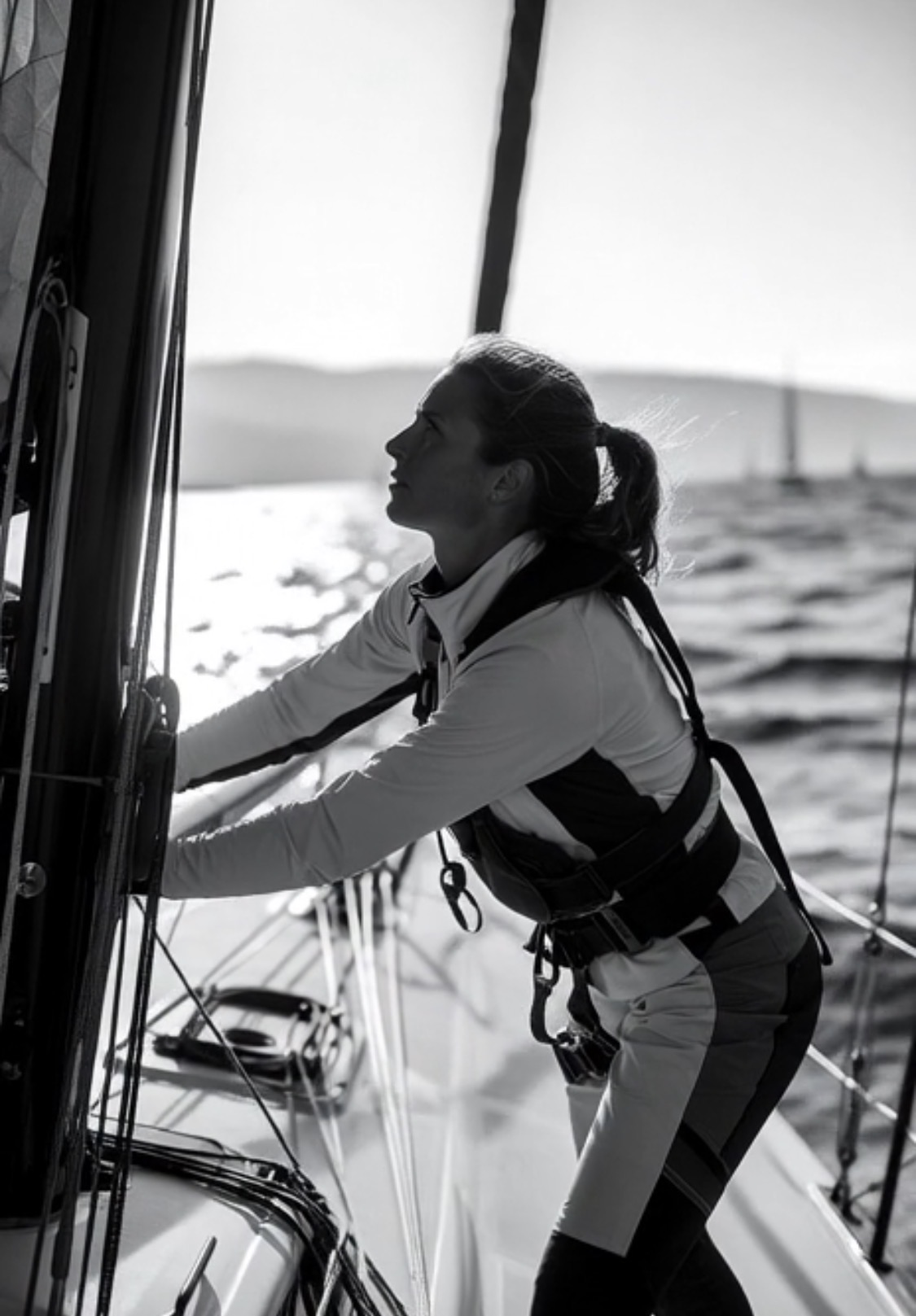
I am an offshore sailor, trained from childhood. I take my share of the watches, I reduce sail, I run the boat solo for hours. If the Captain is asleep or otherwise occupied, ARION does not stop.
MARINE BIOLOGY · UNIVERSITY OF SYDNEY · POLAR FIELD WORK
I take my share of the watches, I hold the protocol.
My discipline comes from Sydney. My field of choice is Antarctica.
Marine biologist, PhD from the University of Sydney, offshore sailor trained from early childhood. More than ten years working on Antarctic cetaceans, from the Peninsula to the Ross Sea, from orcas to baleen whales. For Odyssey of AION, I am taking a sabbatical year, and I keep my independence on what I collect, on what I analyse, on what I publish.
My name is Sarah. I am 38. Marine biology PhD, offshore navigator, trained on a boat since childhood. I was born in Sydney, in a family where the ocean is not a pastime but a given. Dinghy from age six, junior racing in the harbour, then offshore, then sailing measured in weeks rather than hours. The ocean was never an interlude. It was a field.
I am ten the first time a southern right whale drifts into the bay one winter morning. The breathing, the sound of air expelled, the mass gliding under the tender without making a wave. I did not really decide afterwards: everything fell into place from there.
Studies at the University of Sydney. Marine biology, then PhD, focused on Southern Ocean cetaceans: ecotypes, distribution ranges, the way of holding an observation framework when the ocean gives no respite. I preferred long campaigns to laboratory careers, slow vessels to fast boats. Ten years of polar and subantarctic field work. Publications, yes, but above all catalogues, time series, datasets others can pick up. I publish little. I share a lot of data.
"On deck, I record. Sorting happens later, warm, indoors." Sarah
In early 2020, I board ARION with colleagues for a study mission in the Ross Sea. The Captain holds the course. I hold the protocol. The boat keeps us in the South longer than planned, then beyond the South longer than planned. Odyssey of AION was born of that meeting: a boat able to hold the South, a biologist able to hold the framework, a route that demands both.
For the expedition, I am taking a sabbatical year. Not a comfort choice, a necessity. The Southern Ocean below 60°S is not visited in two weeks. And keeping my independence in analysis and publication is what keeps the work valuable. I am no longer here to learn what the Southern Ocean is. I am here to run one more route through it.
Three axes, not one. Navigation redundancy, the scientific framework, analytical independence. At sea in the Southern Ocean, a two-person expedition holds because each role holds the other.
I am an offshore sailor, trained from childhood. I take my share of the watches, I reduce sail, I run the boat solo for hours. If the Captain is asleep or otherwise occupied, ARION does not stop.
Photo-ID, passive acoustics, homogeneous metadata, certainty scales. The discipline I bring on board so an encounter becomes an observation other teams can use.
Sabbatical year, no institutional contract constraining what I publish or when. Data serves the expedition first, then partner teams, on the pace and in the format I judge right.
The same standard, on two fronts: continuity at sea (watches, manoeuvres, decisions) and scientific continuity (observe, annotate, make comparable). Value does not come from a "spectacular" moment, but from clean, contextualised, cross-referenceable series.
Offshore culture, deck discipline, watch-keeping and manoeuvres in hard weather.
Field rigour: identify, note, compare, verify, useful to other teams.
Acquisition, annotation, analysis: solid metadata, controlled certainty, comparable series.
Image/sound/notes archive. Here, scientific "premium" means continuity.
"In these latitudes, the rarest thing is not seeing. The rarest thing is being able to compare. What creates value is continuity: same framework, same metadata, sustained over time."
Sarah, Marine biologist, navigator
Raw sequence: real pace, real conditions, method in contact.
I grew up in Australia surrounded by sailing: dinghy, racing, then offshore. I have sailed across a range of boats, from training vessels to racing yachts, through bluewater cruisers and boats prepared for cold-water passages.
What this background gave me is what I find most useful on an expedition: a pragmatic reading of the boat and the elements. In the south, competence is not spectacular. It is anticipation, quality manoeuvres, consistent routines (watches, checks, safety), and clear-headedness when the weather takes over.
At high latitudes, windows are short and decisions must stay sober. This offshore culture is not decoration. It is what lets me keep continuity, day after day, when cold, sea and wear become operational parameters.
I specialised in cetaceans because it is a field that demands rigour: identify, note, compare, verify. At high latitudes, encounters are brief, conditions change fast, and observation "by luck" is worthless without a stable framework.
My field work covers Antarctica, from the Peninsula to the Ross Sea. I document every variety of Southern Ocean orca, types A through D, and the great baleen whales that come down to feed there in summer. Photo-identification (fins, scars, pigmentation) remains my main tool, paired with the analysis of distribution ranges from multi-source data: shipboard observations, passive acoustics, and environmental variables (ice, sea surface temperature, productivity).
What this brings to Odyssey of AION is straightforward: a way of working that produces what lasts. On an engaged circumnavigation, scientific continuity depends on a presence capable of holding the sea as well as the protocol.
Here, "premium" means: clean data, contextualised, comparable. The value of an observation is not its rarity, it is its reproducibility.
Between field missions and analysis work, the objective remains the same: structure series that are useful to other teams, beyond the narrative.
I capture cleanly: readable photo-ID, short sequences, stable settings, noted context. The goal is not the spectacular image, it is the comparable one.
An observation is worth what its metadata is worth: position/time, conditions, behaviour, group composition, certainty level. Without that, I do not log anything.
I build cross-comparable series (season, zone, individuals) to feed catalogues, distribution analyses and testable hypotheses.
In the Southern Ocean, the challenge is not "seeing", it is connecting. Hold a framework, repeat, stack. That is what turns a rare encounter into lasting information.
Four in the morning, somewhere below 50°S.
Outside temperature minus three, gloves soaked through, camera in a waterproof pouch. A blow in the distance, three seconds to decide. I note the position and the time first, I observe, I shoot in sequence. No excitement upfront: excitement eats attention.
The first read of the images comes in the evening, warm, in the saloon. That is where the fins speak, not on deck. Years of field work to learn that the instant matters only if it enters a catalogue the day after.
I work with several Australian institutions focused on Southern Ocean cetaceans. Data collected aboard ARION will feed shared catalogues and databases, in formats compatible with existing protocols.
During the expedition, I am on a sabbatical year. This independent status lets me choose what I publish, at what pace, and with whom. Priority results go first to the expedition, then to partner teams, then to the public.
I will detail the institutional partnerships before departure.
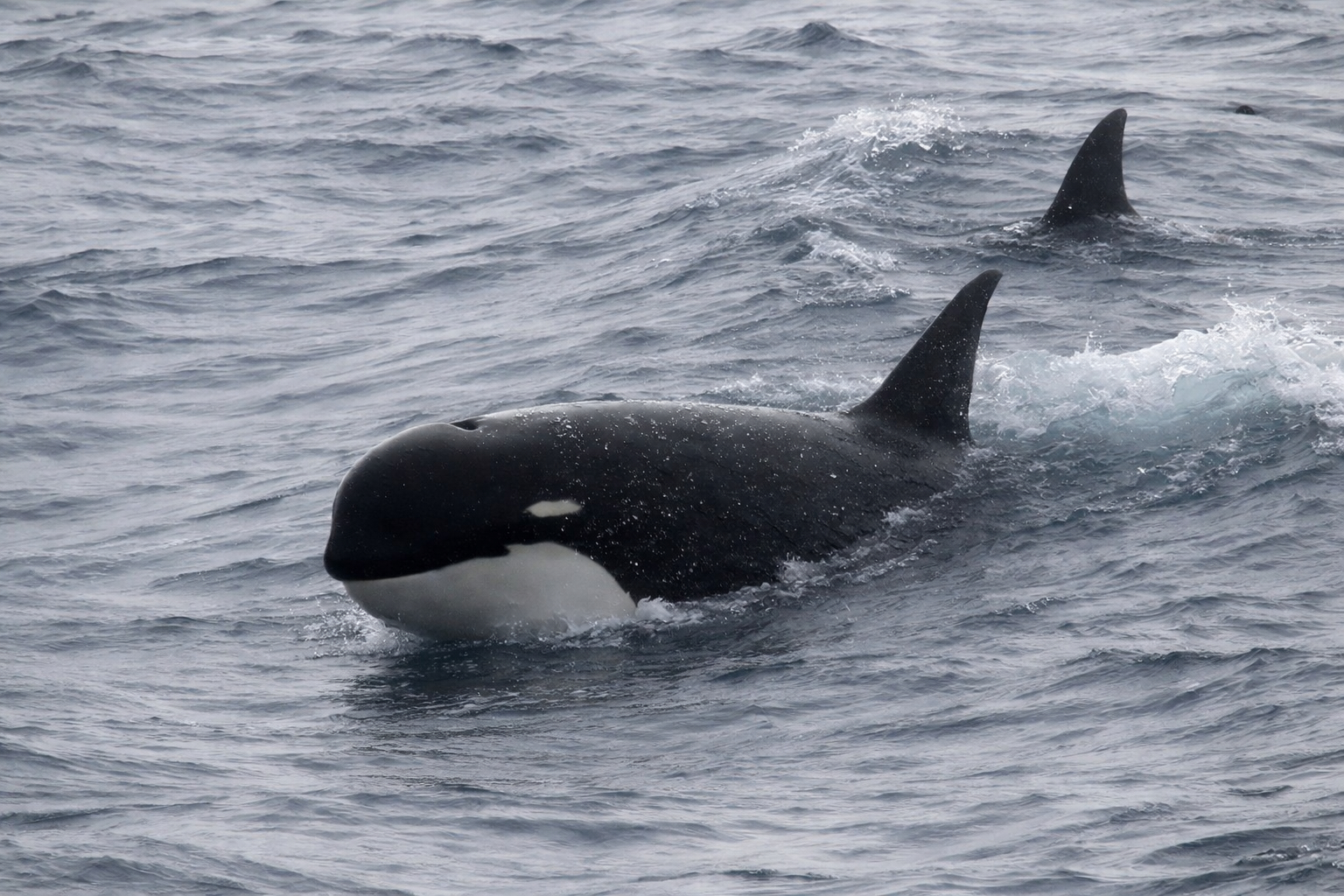
Beyond orcas, I work on Antarctic baleen whales. Value comes from context (time, sea, ice, heading) and from repetition.
My campaigns aim to clarify migration timing, feeding zones and inter-annual variability. What looks small on the scale of a single day becomes significant when I accumulate series over weeks and months.
Odyssey of AION adds a useful layer: regular observations, in the same format, in zones where continuity is missing.
Observations, images, sounds and environmental data are archived in the AION Scientific Data Hub. If you work on high-latitude cetaceans or passive acoustics: let's talk, frame it properly, build something clean.