What matters here
- Repairable hull and tolerant structure
- Control at low speed and readable handling
- Maintenance access compatible with remoteness
- Liveable aboard in hard sea for two
- Comprehensible, non-invasive systems
EXPEDITION YACHT · ALU STRONGALL HULL
Built to take it.
Made to go the distance.
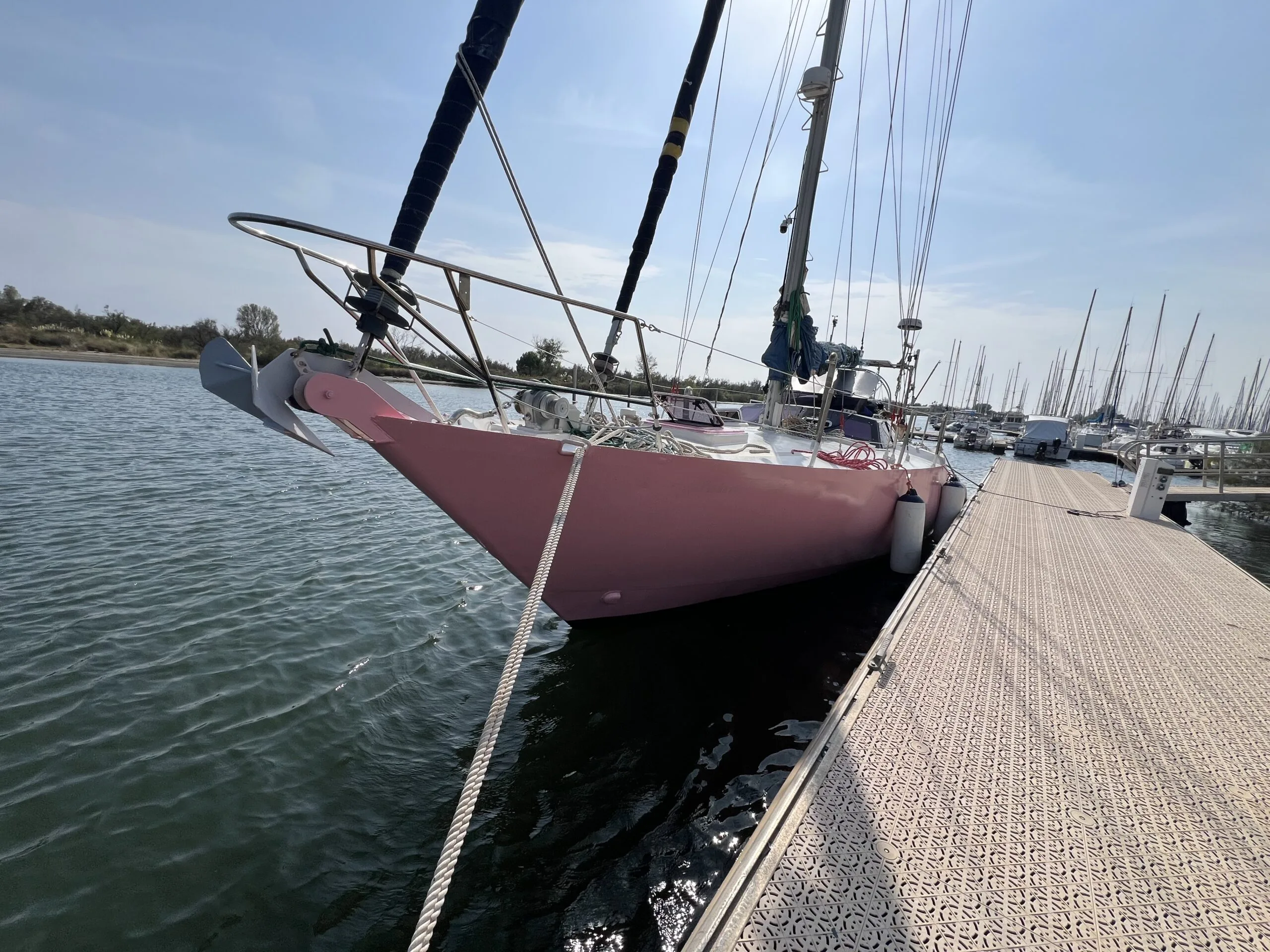
ARION was not chosen for its image or an abstract notion of a "polar boat". The choice rests on a set of trade-offs that favour a long, cold and exposed route: aluminium hull, heavy scantlings, swing keel, tolerant handling, realistic repairability and volume compatible with two people over an extended period.
In this programme, the right boat is not the fastest in a good weather window. It is the one that remains workable when the cold sets in, manoeuvres repeat, fatigue accumulates and an incident allows neither yard nor assistance.
The 47 feet, displacement, ballast, heavy aluminium, swing-keel principle and hull scantlings shape a platform that prioritises endurance over responsiveness. For this programme, this is not a detail: the longer the route, the more critical the boat's capacity to absorb without coming apart.
In drifting ice, near a shoreline, in a cross-sea or when the boat needs nursing, a yacht must remain readable and controllable at low speed. All of ARION's preparation aims to preserve this quality: simple manoeuvres, understood inertia, predictable responses and contained mental load.
The refit does not aim to transform ARION into something else. It aims to make more coherent what the boat already does well: better protection on watch, consolidating the seamanship architecture, clarifying maintenance access, improving cold tolerance and removing everything that unnecessarily complicates the route.
In the Sixties, communications are not a comfort. They are a safety and continuity requirement: weather, routing, shore contact, scientific data, emergencies. The logic is the same as for energy: multiple sources, clear hierarchy, immediate switchover.
Rather than a statement of intent, direct answers to the questions sailors most often ask when they discover ARION and its programme.
Aluminium sinks less readily than steel on a mild impact, it bends and tears less. It can be repaired cold, with arc or wire, using the tools carried aboard.
Strongall is a high-yield-strength aluminium grade, 10 to 25 mm thick on the underwater hull. Not a thin plate painted white, a hull built to absorb a rough sea, a scraping growler, a controlled grounding.
Steel offers the same tolerance but doubles the weight and demands constant fight against corrosion. Composite can't be repaired cold. Strongall aluminium checks every box for a long expedition.
A fixed keel with 3 m draught closes off the Patagonian caletas, shallow-water zones, tidal groundings. It rules out beaching, the technique of resting the boat on its bottom at low tide to service the hull or change a part.
The swing keel lifts, drops, modulates. Raised, it sits in the sump under the hull and draught falls to 1.3 m, we can go anywhere. Lowered, we have 3.2 m of lateral plane to claw to windward below 60°S.
The 5.2 t ballast is on the keel itself, not on the hull bottom. Versatile platform, performance preserved.
In heavy weather, you don't change headsail by feeding a jib on a pitching foredeck. You roll the genoa in and unfurl the staysail, without leaving the cockpit.
Two furlers, two stays. Genoa for close-hauled and downwind up to 30 knots, staysail from 30 to 45. Beyond that, we heave to under a triple-reefed main or under storm jib. Most of the time, the cutter rig lets us reduce remotely, without putting ourselves at risk.
The inboard handles daily propulsion: the original MWM, still in place. Replacing it with a more recent 115 hp engine is a target of the refit. A second engine is mounted on the stern platform on a reinforced bracket built for it, a 60 hp outboard with strong low-speed thrust and a 4-blade propeller.
In Patagonian channels, surplus power isn't a luxury. Caletas are negotiated slowly, against catabatic wind and current, sometimes through a single-passage channel. An engine that stalls under those conditions, and the boat goes sideways in thirty seconds.
With two engines, we free ourselves from ice traps that don't exceed a metre thick, we claw upwind against current, we pull off a shoal. Redundancy is what makes margin useful.
A 2.60 m plastic tender doesn't survive a 100-knot gust. It takes off like a kite. In those conditions, even the life raft isn't deployable before blowing away. We needed a different logic.
ARION's tender is 4 metres of aluminium, unsinkable by construction. Designed as a barge, you load it, you tow with it, you work on it. Built by students of a technical school in Chambéry.
It doesn't sit on stern davits, none would hold its weight with engine, fuel and gear. It rides on deck, deployed and retrieved by a custom cargo boom.
It serves for everything, complementary escape route to the life raft, pulling ARION off a shoal, deflecting a bergy bit drifting onto the mooring lines, fetching firewood in a caleta, carrying jerrycans. A tender on the boat's scale, it's not a gadget.
For the circumnavigation, nothing is decided. It may stay in Patagonia with the windlass, the 150 m of 12 mm chain and the three anchors. For the loop below 60°S, we take only what's strictly necessary.
Just enough. Below 60°S, we consume 250 to 400 Ah per day across Starlink, radar, AIS, autopilot, electric backup heating, fridge, lighting, personal gear charging.
With 1800 Ah LiFePO₄ (around 1,440 usable in cycling, without the punishing deep discharge of lead-acid), we hold three days without production during a storm with no solar or wind input, which happens. Beyond that, the inboard genset takes over.
The real constraint isn't battery volume. It's cold protection, which blocks charging below 0°C. Insulated locker, temperature sensor, active management.

Three layers of defence. The aluminium hull insulated with 80 mm of sprayed polyurethane, anti-condensation coating on the floors, wood cladding inside. That already cuts half.
Main heating is diesel-fired forced-air, 5 kW, fed from a dedicated tank: around 400 hours of running time, used in bursts, enough to cover months of rationed use. Blown into every berth and the saloon.
Backup heater runs on kerosene or wood, fully independent of the electrical system. If everything fails, it heats. You don't freeze to death aboard ARION as long as there's fuel.
60 l/h watermaker, 12 V motor, 24 A while producing (manufacturer figure). We produce more than we consume even in overcast weather. Buffer reserve, two 300 l stainless tanks inside.
On the circumnavigation, we make water as we go. We use 10 to 15 litres per person per day, drinking, cooking, reduced washing. No showers.
Redundancy, if the watermaker fails, the 600 l reserve covers 20 days for two. Beyond that, rationing and rain collection.
Starlink Ocean covers the Antarctic circumpolar zone thanks to inclined LEO satellites. Below 60°S it works, with more frequent service gaps south of southern Argentina and in some South Pacific sectors.
Useful throughput 25 to 100 Mbit/s, enough for GRIB weather, emails, partner exchanges, transmission of scientific data. Not enough for streaming, we do without.
Mandatory redundancy, Iridium GO! as permanent backup. If Starlink drops, Iridium handles weather, emergency messages, position. Two independent channels, two operators, two different orbits.
Raymarine Quantum radar, useful range 24 miles on large icebergs, 6 to 8 miles on bergy bits of 5 to 10 m. Below that size, radar struggles.
Growlers, ice fragments barely breaking the surface at 1 to 3 m, are the real trap. They don't return a radar echo, and aren't visible before 30 m to the naked eye, 100 m with a searchlight. At 7 knots, that gives ten to thirty seconds to avoid.
The countermeasure, reduced speed at night in ice zones (5 to 6 knots), systematic visual watch, forward-facing thermal cameras under evaluation for critical sectors. And some luck.
A simple wardrobe, maintained, predictable. Offshore main with three reefs, Kevlar reinforcements at the stress points, able to be fully dropped from the cockpit. 135% genoa on furler for 0 to 30 knots. Staysail on furler for 30 to 45.
Beyond that, dedicated storm jib hoisted on removable stay, 6 m². Main replaced by a trysail for running off bare or nearly so. Storm sails stowed in a numbered bag, accessible without light.
Rule: reduce before you need to. A sail flogging at 40 knots is a ruined sail and an exhausted crew. The current wardrobe is solid but cut large: short-handed, it stays demanding to work over time. A reduced set, smaller genoa and a four-reef main, is the first post to upgrade if a partner steps in.
Three advantages. A full infirmary, basic surgery, broad-spectrum antibiotics, major analgesics, immobilisation gear, defibrillator. Standard polar-expedition equipment, validated protocols.
Medical competence aboard, Captain's medical training, Sarah's expedition-medicine training. No specialist, but enough to diagnose, stabilise, decide on a retreat.
Twenty-four/seven teleconsultation via Iridium or Starlink. A maritime medical service takes over on complex cases, remote diagnosis, emergency protocol. Knowing that below 60°S, extraction takes several days.
Through-hull valves in PTFE rather than brass, less seizing in the cold. Sea-water circulation jacketed, traced with backup heating on critical elbows.
Diesel treated with anti-waxing additive from the equator onwards, pre-heated circuit. Batteries in insulated locker with temperature sensor, charging is cut below 0°C (lithium freezes chemically).
Fresh water in interior tanks, not under the cockpit. Watermaker shut down and purged between runs to prevent freezing in the membranes. Every system has its winter protocol, documented.

On a route this long, the question is not how much you can produce on paper. The question is what remains when one source fails, a bank must be isolated, cold extends consumption or several overcast days erode the margin.
ARION's energy architecture is designed to remain usable in degraded mode: two separate banks, distributed production, independent primary heating, limited 220V, and the capacity to quickly restore reserve without immobilising the boat.
The principle is not to optimise one source, but to never be captive to a single one.
Here, power only makes sense if it quickly restores margin without complicating the route.
In the Sixties, a boat rarely degrades on a single big event. More often it wears by accumulation: impacts, spray, moisture, broken watches, minor failures, repeated manoeuvres and fatigue. Good preparation therefore consists not only in reinforcing, but in slowing this consumption of boat and crew.
This implies simple routines, comprehensible systems, a clear hierarchy of uses, autonomous heating, and manoeuvres that remain feasible when lucidity fades.
A boat neither spectacular nor fragile: a boat that can still be operated cleanly after several hard days, in the cold, with fatigue, partially degraded systems and a margin that must remain readable.
Command, method, background: who sails ARION into the Sixties and how decisions are made.
Data collected by ARION underway: weather, ice, oceanography, onboard energy, access for researchers.
Technical partnerships, targeted support or sponsorship: how to concretely join the project.
Running an Antarctic sailing circumnavigation without a lead sponsor is a choice. A 1952 MWM engine, overbudgeted sails, a makeshift watermaker, every line item was weighed between what is viable and what would be ideal. This page documents the real figures, the real gaps, and why the expedition is departing regardless.