Odyssey of AIONPatagonia → Southern OceanCommand • Autonomy • Fieldwork
Mastering the extreme, leading the impossible.
In the Sixties, no port, no stopover. Depressions every 48 to 72 hours, seas of 12 to 15 metres, icebergs invisible at night.
Two crew, a 14.32 m yacht, several months without a port of call to hold the loop. The nearest icebreaker is several days away, in the best conditions.
Holding in these conditions cannot be improvised. It is prepared, structured, documented.
25 years. 120,000 NM. A boat built to take it, not to impress.
Experience25+ years offshore
Miles sailed120,000 NM cumulative
CommandCaptain 500 UMS (STCW)
ZoneSouthern Ocean
The Captain's word
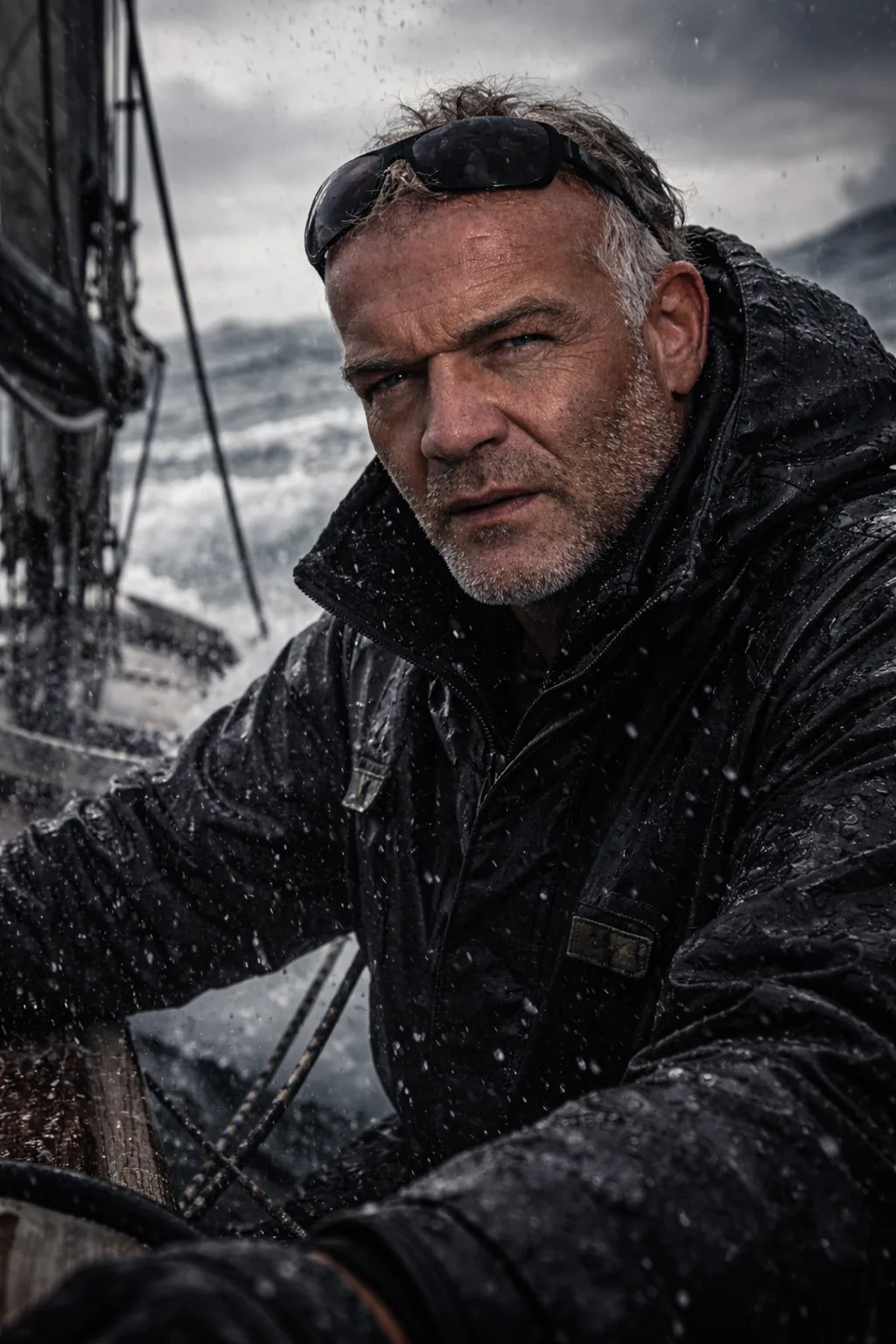
I did not choose the South because it is rare. I chose it because it is honest. Down there, a sound decision shows itself within hours. A rough one does too. No port of refuge, no possible stopover, depressions back to back and the next one arrives before the previous has been absorbed. Ice that dictates the terms. Tabular icebergs tens of kilometres long in permanent drift. Bergy bits that radar does not see. A felt temperature of −25 °C. Weeks on end without neutral ground.
It was not rarity that decided this project.
The logic is simple: this navigation demands sailors who operate over the long run, not in the moment. Three-hour watches strung together for months. Decisions to make when fatigue has been there for a long time; it is in those conditions that lucidity holds, not that it fades. That is what medicine teaches. And that is what the South demands.
Sarah brings scientific rigour and a knowledge of the far South that changes the nature of the project. She holds the protocol. I hold the route. Together, a capacity to remain operational when conditions leave no choice, and without anyone coming to pull us out if it goes wrong.
ARION, 47 feet of aluminium, 17 tonnes. More than my boat, it is something that no longer needs explaining. ARION does not speak. But at these latitudes, it is often ARION that has the last word.
The risks are known. Not in the abstract, concretely, sector by sector, with the numbers. That is what makes this project solid, not what makes it reckless.
The Captain ARION · Odyssey of AION
Why the South
Looking for what is hard, because what is hard does not lie.
Why this particular loop, and not another. Why south of 60°S, and not south of 50°S.
Why with a crew of two, and neither solo nor with four. The project was not shaped by accumulating wants,
but by elimination: at each choice, the most demanding constraint settled it.
South of 60°S: this is the latitude beyond which the full loop becomes a coherent object,
a continuous route, with no cheating on geography.
Crew of two: it is the format that sustains duration without degrading decision-making.
A single operator cannot hold months of watches; four dilute the chain of command.
No stopover, no assistance: it is the only scale that forces real technical and energy autonomy.
Any other version of the project would have been more comfortable, and less accurate.
In the Sixties, there is no turning back at mid-course. No port of refuge. No realistic rescue within reach.
A mistake no longer costs you time, it can cost you the boat. That is why down there you don't "manage" surprise:
you reduce it, before it becomes irreversible.
From offshore to command: method, margins and operational endurance
The common thread: making navigation reproducible and verifiable. Weather decisions, margins, energy, maintenance, safety, sustaining a long expedition while producing usable observations.
First transatlantic. The trigger: leaving medicine, switching to maritime training, STCW certifications.
Medicine is not forgotten, it becomes method. Diagnose under pressure, triage urgency, follow protocol when lucidity drops,
exactly what navigation in a degraded environment demands.
Long-distance deliveries. Atlantic, Pacific, varied platforms, temporary crews, GRIB/ECMWF routing.
Each delivery is a controlled compromise: weather window against fatigue, speed against wear, comfort against safety.
One single priority: arrive without breaking.
The Captain, Antarctica 2025
Garcia Exploration 60, cold seas. Aluminium, full keel, navigation focused on the far North and far South.
Condensation, icing, accelerated ageing, energy to defend every day.
Performance becomes secondary to the capacity to endure.
Captain 500 UMS, command of private yachts. Full responsibility, 24/7, for safety, vessel integrity and programme.
This is where the reflexes useful in the South are formed: defining thresholds, refusing a borderline window, waiting,
walking away without regret when the margins disappear.
Today, ARION. 14.32 m Strongall aluminium. Already proven in the South: in early 2020, a long mission in the Ross Sea, biologists aboard, the one where the encounter with Sarah took shape. Not an occasional boat to "go South", a platform built to remain there.
Heavy structure, simplified but redundant systems, maintenance access, reinforced energy autonomy.
The goal is no longer the expedition, it is the committed route in the Sixties while limiting technical debt.
Turning point
From medicine to the sea
Transatlantic → STCW → professional framework, procedures, and fieldwork practice.
Offshore
Deliveries & crossings
Oceans, real weather, continuity vs wear trade-offs.
Offshore diagnosis and repair, prevention, system access, critical spare management.
Multi-season expedition
Planning, logistics, safety, and integration of data and narrative without disrupting operations.
Science
Long presence, simple measurements, solid metadata
Science is not an add-on to navigation: it is what justifies the duration.
Without usable data, a committed circumnavigation is only a performance.
With it, it is a long presence in an under-sampled zone, useful to others beyond us.
A committed circumnavigation places a yacht for extended periods in under-sampled zones.
The approach is pragmatic: continuous measurements, properly contextualised
(position, time, conditions, protocol).
Protocols and data series are developed with marine biologist Sarah,
so that the data is usable beyond the narrative: consistency, traceability and metadata.
Weather & atmosphere
Time seriesFieldworkExport
Pressure / wind / synoptic context in a zone with low density of in situ observations.
Ice & cryosphere
In situNotesImagery
Ice type encountered, local dynamics, possible cross-referencing with satellite imagery.
Opportunistic oceanography
CTDSalinitySamples
Profiles and sampling correlated to the actual track and sea conditions.
Passive acoustics
HydrophoneWildlifeMetadata
Recordings with metadata (position/time/conditions) designed for reuse.
A feature-length documentary is being filmed on board throughout the entire expedition.
Continuous 4K capture, two operators with no external crew: The Captain and Sarah.
The film follows the full chronology: preparation in Marseille, the solo transatlantic,
the crew change in Ushuaia, the Drake Passage, the circumnavigation south of 60°S.
The angle stays grounded in the field: weather decisions made under fatigue, energy defended every day, maintenance offshore,
the physical presence of ice, long sections without real shelter. No staging, no reconstruction.
What will be seen on screen is what will have been lived.
The high points will take shape during shooting: the first depressions of the South Atlantic, the technical passages of Patagonia,
the first ice, the committed route in the Sixties. The narrative structure will emerge in editing,
from the rushes and from the logbook kept every day, at sea as on shore.
The film is intended for festival distribution followed by wider release. Production and post-production terms
are being finalised with partners.